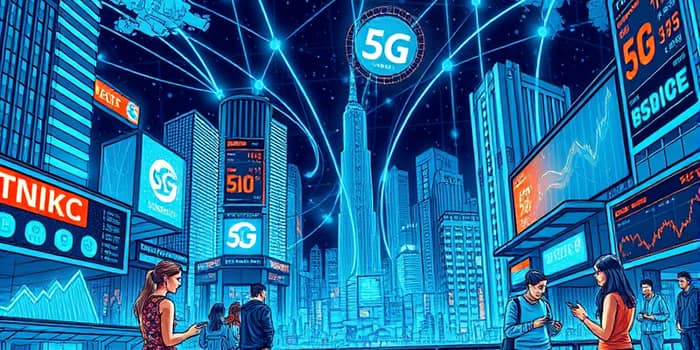
As 5G networks sweep across the globe, financial institutions are standing at the threshold of an unprecedented era. With ultra-fast transmission speeds and ultra-low latency, this next-generation technology promises to reshape banking, trading, customer experience, and global inclusion.
The convergence of speed, reliability, and massive device connectivity is not just an upgrade—it’s a wholesale reinvention of how money moves, how markets operate, and how citizens engage with financial systems.
The New Digital Backbone of Finance
At its core, 5G elevates network performance to new heights. Compared to 4G, it delivers 10 to 100 times faster data rates and latency under one millisecond. Financial firms can process vast streams of information in real time, enabling automated trading systems to execute orders in the blink of an eye.
Beyond speed, 5G’s architecture supports massive IoT deployments. Branch offices, ATMs, wearables, and customer mobile devices can all operate concurrently without network congestion. This foundation allows banks to build resilient edge computing platforms, decentralize services, and bring critical processing closer to users.
Key Transformations Empowering Financial Services
From trading floors to remote villages, 5G is driving innovation at every level. Financial institutions are pioneering new use cases that blend artificial intelligence, immersive technologies, and seamless connectivity.
- High-frequency trading and capital markets: With sub-millisecond latency, algorithmic traders benefit from near-instant trade execution, reducing slippage and seizing market opportunities faster than ever.
- AI, Machine Learning and Data Analytics: Banks can deploy real-time analytics for credit underwriting, hyper-personalized offers, and fraud detection. Models update continuously, spotting anomalies and adapting to evolving risk patterns.
- Immersive banking experiences: Augmented reality-assisted remote support, virtual branch tours, and live product demos create engaging touchpoints. Wearable payments and cross-device authentication simplify transactions on the go.
- Enhanced security and fraud reduction: High-bandwidth connections power multi-modal biometric checks—face, voice, and behavior analysis—cutting fraud losses and boosting customer trust.
- Expanded financial inclusion worldwide: Affordable 5G devices and mobile banking apps bring services to underbanked communities, bridging gaps in remote regions and supporting sustainable economic growth.
Together, these transformations drive efficiency, spark competition, and deliver richer experiences to customers across the spectrum.
Risks and Challenges on the Horizon
Embracing 5G also brings new vulnerabilities. The flood of connected endpoints and sensitive data streams expands the attack surface for cybercriminals. Institutions must reinforce their defenses to protect customer assets and privacy.
- Cybersecurity threats: IoT devices and edge nodes require robust encryption, continuous monitoring, and zero-trust frameworks to ward off sophisticated breaches.
- Infrastructure modernization hurdles: Upgrading legacy systems, retraining staff, and integrating cloud and edge computing demand significant investment and strategic planning.
- Regulatory and ethical considerations: Rapid data flows across borders raise compliance questions. Regulators and banks must collaborate to balance innovation with ethical data use and consumer protection.
Addressing these challenges head-on will be critical for banks to maintain resilience and customer confidence in a hyper-connected world.
Economic and Competitive Implications
5G is more than a technical upgrade—it’s a catalyst for economic growth. According to industry forecasts, the technology could contribute an estimated $55 billion to global financial services by 2030. Early adopters stand to gain productivity boosts and competitive advantage.
Financial institutions that harness 5G-driven analytics and edge computing can streamline operations, reduce costs, and deliver services with unprecedented efficiency.
The Road to 2030 and Beyond
As the 5G rollout accelerates, banks and fintechs must develop clear strategies to integrate new capabilities. This involves:
- Investing in cloud-edge hybrid architectures to optimize data processing.
- Deploying advanced AI models that adapt in real time to market changes.
- Partnering with regulators and technology providers to establish secure, interoperable frameworks.
By 2030, we will witness a financial ecosystem where branch visits become optional, transactions complete in milliseconds, and tailored services reach every corner of the globe.
In this new era, institutions that embrace innovation, prioritize security, and focus on customer-centricity will shape the future of finance. The speed and reliability of 5G open doors to possibilities once thought impossible—transforming banking from a service into an experience, and finance from a privilege into a universal right.
References
- https://www.deltecbank.com/news-and-insights/the-impact-of-5g-in-financial-services/
- https://www.financierworldwide.com/5g-and-financial-services
- https://www.suntecgroup.com/articles/when-banking-meets-5g-ushering-in-a-new-era-of-banking-innovation/
- https://globalfintechseries.com/featured/5g-and-financial-inclusion-redefining-access-to-banking-in-the-digital-age/
- https://www.5gamericas.org/the-state-of-5g-growth-challenges-and-opportunities-in-2025/
- https://www.gsmaintelligence.com/research/the-mobile-economy-north-america-2025
- https://www.weforum.org/stories/2025/01/5g-mobile-networks-digital-transformation/
- https://www.ericsson.com/en/press-releases/5/2025/emr-june-2025-5g-and-fwa-drive-broadband-evolution-in-middle-east-and-north-africa-by-2030